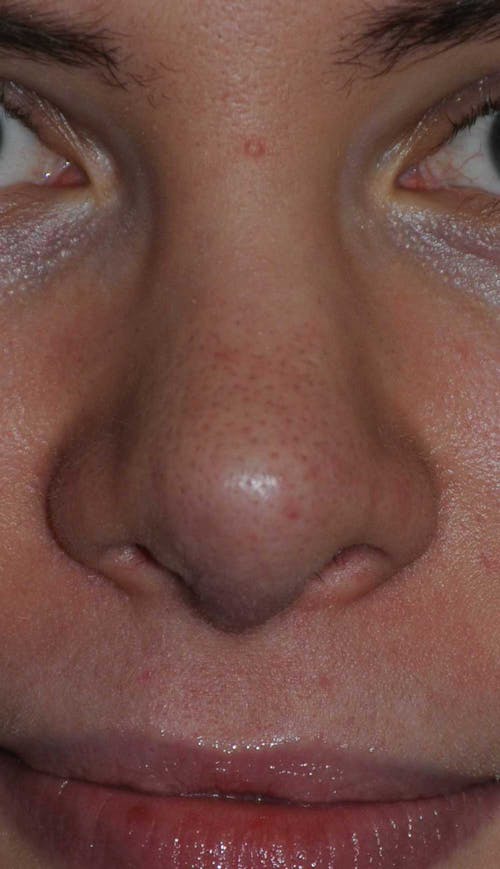
Rhinoplasty Terms & Definitions

  • Accessory Cartilage: Cartilage tissue connected by fibrous bands to the lower lateral cartilages and the pyriform aperture (the bony opening of the nose formed by the maxilla, nasal bones, and frontal bone). These structures provide support and help maintain the airway.
  • Alae: Fibrofatty tissue forming the outer portion of the nostrils. It contains no cartilage and is composed of fatty tissue, collagen, elastin, skin, and muscle coverings. Adjustments to this area can narrow the base of the nose and refine nostril shape.
  • Alar Base: The area including both alae and the base of the nose. Ideally, this aligns with the inner corners of the eyes (medial canthi). Surgical techniques such as alar wedge excisions can narrow this area.
  • Alar Groove: The natural crease between the ala and the nasal sidewall.
  • Alar Rim Graft: A graft placed along the lower edge of the nostril to provide support and prevent collapse.
  • Anatomic Dome: The most projecting point of the nasal tip, where the lateral and intermediate crura meet.
  • Anterior Septal Angle: The angle formed by the dorsal and caudal septum. This plays a key role in tip position, projection, rotation, and nasal length.
  • Binder Syndrome: A developmental condition affecting the nose and upper jaw. It may include the underdevelopment of nasal and maxillary structures and can impact facial balance and function.
  • Bony Vault: The bony framework of the nose, consisting of the nasal bones, maxilla, and frontal bone.
Banner media

Schedule A Consultation

Contact Us

Structural Anatomy Terms

  • Columella: The tissue between the nostrils, composed of the medial crura and surrounding soft tissue.
  • Columellar–Lobular Angle: The angle between the underside of the nasal tip and the columella, typically 35–40 degrees.
  • Dorsum: The nasal bridge extending from the glabella to the supratip area.
  • External Nasal Valve: The outer opening of the nostril.
  • Infratip Lobule: The area between the tip-defining points and the columella.
  • Intercartilaginous Incision: An incision between the upper and lower lateral cartilages, often used in closed rhinoplasty.
  • Internal Nasal Valve: The narrowest part of the nasal airway, responsible for a significant portion of airflow resistance.
  • Keystone Area: The junction where the nasal bones meet the cartilaginous septum and upper lateral cartilages.
  • Limen Vestibuli: The junction between the upper and lower lateral cartilages, also known as the scroll area.
Quote media
Accent media
Accent media Accent media

“My goal was to find a method to bring back a person’s natural youthfulness without the operated, unnatural look and that is why I have my patients bring in photos of them when they were age 5 to 30. My YoungVitalizer helps restore natural and youthful contours they haven’t seen in years.”

— Dr. Philip Young, Seattle Facial Plastic Surgeon

Cartilage & Tip Anatomy

  • Lower Lateral Cartilages: Cartilages that shape the nasal tip and lower third of the nose, consisting of:
    • Lateral crus
    • Intermediate crus
    • Medial crus
  • Marginal Incision: Also called an infracartilaginous incision, following the lower edge of the lower lateral cartilages.
  • Medial Crura: The portion of cartilage forming the columella.
  • Medial Crura (Footplate): The segment extending along the floor of the nostrils.
  • Nasal Lobule: The tip region of the nose, bounded by the supratip, alae, and columella.
Foggy tree line

Facial Landmarks & Angles

  • Nasion: The soft tissue depression between the forehead and nasal bridge, corresponding to the bony radix.
  • Nasolabial Angle: The angle between the nose and upper lip, important for aesthetic balance.
  • Nostril Base: The ridge along the floor of the nostrils, which can be refined to narrow the nasal base.
Banner media

Additional Anatomical Structures

  • Pyriform Aperture: The bony opening of the nose formed by surrounding facial bones; adjustments here can improve airflow.
  • Radix: The bony root of the nose at the top of the bridge.
  • Rhinion: The junction between the nasal bones and cartilage.
  • Rim Incision: An incision along the inner edge of the nostrils.
  • Scroll Area: The overlapping junction of upper and lower lateral cartilages, important for nasal valve function.
  • Sesamoid Cartilages: Small cartilage structures located between the upper and lower lateral cartilages.
  • Soft Tissue Triangle: The delicate area between the tip and the nostril edge.
  • Subnasale: The junction between the columella and the upper lip.
  • Supratip Area: The region just above the nasal tip, contributing to contour and shadowing.

Tip Dynamics & Measurements

  • Tip: The most forward-projecting part of the nose.
  • Tip Domes: The defining points of the nasal tip that reflect light and shape its contour.
  • Tip Projection: The distance the tip extends from the face, often evaluated using proportional measurements.
  • Tip Rotation: The angle of the nasal tip relative to the upper lip.

Surgical Techniques & Incisions

  • Transfixion Incision: An incision between the medial crura and septum, often used to adjust nasal length or projection.
  • Upper Lateral Cartilages: Paired cartilages forming the middle third of the nose and contributing to both shape and airway function.
Background media
Accessibility: If you are vision-impaired or have some other impairment covered by the Americans with Disabilities Act or a similar law, and you wish to discuss potential accommodations related to using this website, please contact our Accessibility Manager at (425) 696-7689.
Contact Us